
You can have the right prospect, a strong offer, and an experienced sales representative and still struggle to start a conversation.
Timing can certainly influence the outcome of a call. But does that mean businesses should only prospect during a few specific hours of the day?
Not necessarily. For Australian businesses running B2B lead generation, appointment setting, telemarketing or B2C campaigns, there is an important difference between understanding when prospects may be more responsive and turning those observations into rigid calling restrictions.
Industry benchmarks can provide useful guidance, but they should not dictate an entire campaign. A better approach is to call during appropriate and compliant periods, test different times, measure actual campaign performance and optimize based on what the data tells you.
Is There Really a Best Time to Call Prospects?
Search for the “best time to cold call” and you will find plenty of recommendations. Some studies identify particular mornings or afternoons. Others recommend specific weekdays. These insights can be useful as benchmarks, but they should not automatically become operating rules.
Consider the variety of people an Australian B2B campaign might target:
- Managing Directors
- Sales Directors
- IT Managers
- Operations Managers
- Facilities Managers
- Finance Directors
- Business Owners
- Marketing Managers
- Procurement Managers
Their schedules can be completely different.
A construction business owner might start work early and spend much of the day away from a desk. A SaaS executive may spend large parts of the day in online meetings.
A facilities manager might suddenly become unavailable because of an operational issue. A professional-services director may move between client meetings throughout the day. There cannot realistically be one perfect calling time that applies to all of them.
Why Strict “Best Time to Call” Rules Can Become a Problem
This is where businesses need to be careful with generic prospecting advice. Imagine a potential client approaches an appointment setting company and says:
“I would like you to do prospecting for me, but please only call between 10 am and 12 pm and 2 pm and 4 pm because those are the best times to call. Also, please don’t call Monday mornings because people are still getting into their working week, and don’t call Friday afternoons because some business owners may finish early.”
At first, these restrictions might sound reasonable.Now imagine adding a few more.
The client doesn’t want calls made during school holidays. They would prefer prospecting to slow down or stop two weeks before and after school holidays.
They also don’t want prospecting during December or January. Individually, every restriction can sound logical.
Collectively, however, they can leave an appointment setting campaign with a very small number of practical calling hours.
For a professional telemarketing operation, that can create significant problems with:
- staffing;
- agent rostering;
- campaign capacity;
- call volumes;
- follow-up schedules;
- productivity; and
- overall campaign viability.
It can also prevent agents from reaching prospects who simply happen to be available outside the supposedly “best” calling window.
The purpose of understanding prospect behavior should be to improve a campaign — not make it almost impossible to operate.
A Benchmark Is Not a Rule
This distinction is important.
If research suggests prospects are more responsive during a particular part of the day, it does not mean prospects should only be contacted during that period.
Suppose historical data shows that one campaign generates slightly more conversations during a particular morning period.
That is useful information.
It might justify allocating additional calling activity during that period. But it does not automatically mean calling should stop for the rest of the day.
A better approach is: Use benchmarks to prioritize activity — not unnecessarily restrict it. Campaign performance should ultimately determine the strategy.
Your Prospects Don’t All Follow the Same Schedule
One of the biggest problems with universal “best time to call” advice is that it assumes prospects behave in roughly the same way.
They don’t. Consider four different Australian industries.
Technology and SaaS
Decision-makers may work relatively standard office hours but spend significant portions of their day in internal meetings, demonstrations, and video calls.
Construction
Owners, project managers, and directors may start earlier and spend significant time on-site.
Professional Services
Partners and directors may have availability between client appointments rather than according to a predictable daily schedule.
Facilities Management
Managers may need to respond to operational issues at short notice, making their availability difficult to predict.
Using the same restricted calling schedule across these industries would ignore how differently their decision-makers work.
Good B2B lead generation and appointment setting should adapt to the audience rather than force every prospect into the same timetable.
Don’t Assume Monday Morning or Friday Afternoon Is Always Bad
Another common piece of prospecting advice is to avoid Monday mornings and Friday afternoons.
Again, these can be useful hypotheses to test. They should not automatically become universal rules. Some decision-makers may be busy organizing their week on Monday morning.
Others may actually be easier to reach before their diary becomes full. Similarly, some people may mentally switch off from new business conversations on Friday afternoon.
Others may have fewer internal meetings and more time to speak. The only reliable way to understand what happens within a particular campaign is to measure it.
If your campaign data consistently shows poor results during a particular period, the strategy can be adjusted.
But eliminating an entire calling period simply because generic industry advice describes it as a “bad time” can unnecessarily reduce opportunities.
Should You Stop Prospecting During School Holidays?
This is another area where assumptions can quickly become restrictions.
Certain industries or audiences may behave differently during Australian school holidays.
That does not necessarily mean an entire lead generation or appointment setting campaign should stop.
Some prospects will be away.
Others will still be working normally.
Some organizations may even operate with fewer internal meetings during quieter periods, potentially changing when decision-makers are available.
The same principle applies to the periods immediately before and after school holidays.
Rather than assuming: “Nobody will answer during this period.”
Ask: “What does our campaign data show?”
That creates a much more evidence-based approach to outbound marketing.
What About December and January?
December and January can certainly create challenges for Australian B2B prospecting.
- Businesses close for Christmas.
- Decision-makers take annual leave.
- Some industries slow down.
- Others remain active.
This means campaign expectations, databases, staffing, and messaging may need to be adjusted.
But there is an important difference between adjusting a campaign and automatically deciding that prospecting cannot happen.
A professional telemarketing strategy should consider the target industry, campaign objectives, available data, and previous results before making that decision.
Seasonality should inform the strategy rather than automatically stop it.
Buyer Intent Can Matter More Than the Clock
There is another reason businesses should not become obsessed with calling windows.
Intent can sometimes be more valuable than timing.
Consider two prospects.
Prospect A has never interacted with your company.
Prospect B has recently:
- visited your service page;
- returned to your website;
- opened an email;
- interacted with your LinkedIn content;
- downloaded a resource; or
- previously spoken with your team.
If Prospect B demonstrates strong buying intent, should your sales team automatically delay contacting them simply because an industry benchmark suggests another period might produce a slightly higher average connection rate?
That may mean missing an opportunity.
Modern B2B lead generation should therefore consider both prospect behavior and timing.
That means asking:
- Who should we call?
- Why should we call them?
- What have they already done?
- What do we know about the account?
- What happened during previous contact attempts?
- Is there a reason to contact them now?
These questions can be far more valuable than simply asking what hour generates the highest average connection rate.
Don’t Keep Calling an Unresponsive Prospect simultaneously
Although rigid calling windows can be counterproductive, timing still matters at the individual prospect level.
Suppose an agent calls someone on Tuesday morning and receives no answer.
They call again at almost exactly the same time on Wednesday.
No answer.
They try again at the same time on Thursday.
Still nothing.
The prospect may simply have a recurring meeting or operational responsibility during that period.
A smarter appointment setting strategy would vary the next attempt.
Different days and different periods provide additional opportunities to reach the prospect.
The purpose isn’t to identify one perfect hour and repeat it.
It is to learn from previous attempts. This is where structured campaign management becomes more useful than relying on one supposedly perfect calling window.
Appointment Setting Shouldn’t Depend on the Phone Alone
Timing also becomes less critical when phone outreach is supported by other channels.
A modern B2B prospect may encounter your business through:
- LinkedIn;
- email;
- website visits;
- content;
- events;
- referrals; and
- phone calls.
For example, an outreach campaign might involve researching and qualifying the account, making an initial call, sending an appropriate follow-up email, engaging through LinkedIn, and making another call later.
The exact sequence should depend on the audience and campaign.
The important point is that phone, email and LinkedIn can support each other.
A prospect who ignores an unknown number today may be more willing to answer another call after recognizing the company name from an email, LinkedIn interaction or previous conversation.
That is why effective appointment setting is about building familiarity and creating relevant conversations rather than simply searching for a magical hour when everyone answers.
What Should Telemarketing Campaigns Measure Instead?
Instead of focusing only on “best calling times”, businesses should analyze actual campaign performance.
Useful metrics can include:
- dial-to-connect rate;
- connect-to-conversation rate;
- conversation-to-appointment rate;
- qualified appointments generated;
- appointment show rate;
- results by weekday;
- results by calling period;
- results by industry;
- results by decision-maker;
- results by lead source;
- number of attempts required; and
- outcomes from follow-up calls.
Over time, patterns should begin to emerge.
Perhaps a particular industry responds better during one part of the day.
Perhaps another performs well later.
Perhaps Friday performs better than expected.
Perhaps timing makes very little difference, but changing the opening message significantly improves conversation rates.
Those are insights worth acting on because they come from the actual campaign, rather than a generic industry benchmark.
The goal should be continuous improvement.
Test → Measure → Learn → Adjust → Repeat
Compliance Still Comes First
Finding an effective time to reach a prospect is only one part of running a telemarketing campaign in Australia.
Businesses also need to understand when they are permitted to call, who they can contact and what compliance requirements may apply to the campaign.
This is particularly important because a productive calling time and a legally permitted calling time are not necessarily the same thing.
Australian telemarketing campaigns may need to consider requirements relating to calling times, caller identification, ending calls when requested and the Do Not Call Register.
There is also an important distinction between B2B and B2C cold calling. Businesses should not simply assume that the same rules apply to every phone number or every type of outbound campaign.
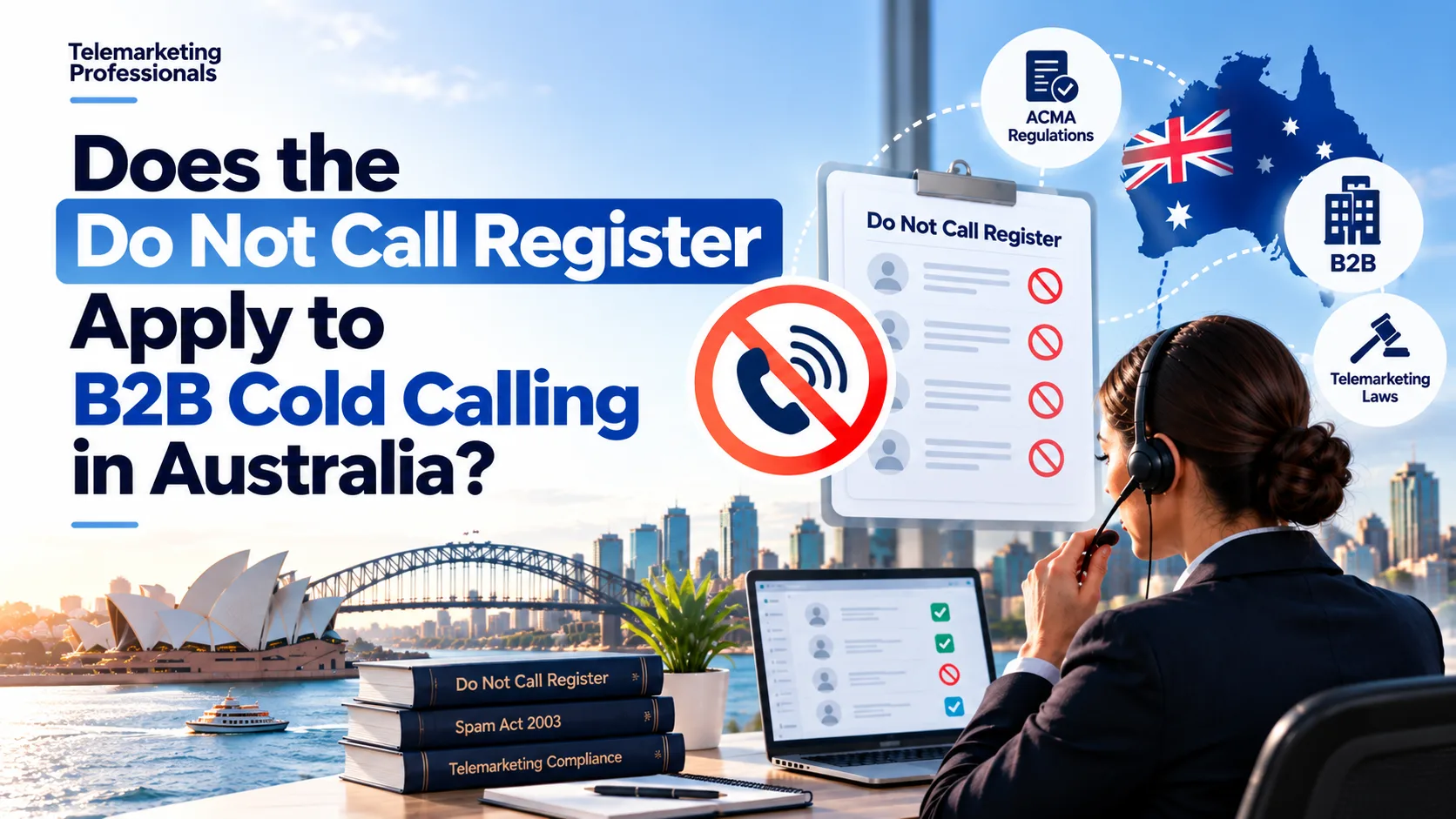
If your organization conducts business prospecting, read our detailed guide: [Does the Do Not Call Register Apply to B2B Cold Calling in Australia?]
The guide explains the Do Not Call Register in the context of Australian B2B cold calling and provides additional compliance considerations businesses should understand before running an outbound campaign.
The practical takeaway is simple:
Compliance defines the boundaries of a campaign. Performance data helps optimise activity within those boundaries.
Businesses should therefore avoid choosing calling times based solely on a “best time to call” statistic.
First understand the relevant compliance requirements.
Then test different appropriate calling periods and use actual campaign results to improve the strategy.
How Telemarketing Professionals Approaches Timing
At Telemarketing Professionals, timing is only one component of an effective outbound campaign.
Successful appointment setting, B2B lead generation and telemarketing also depend on reaching the right prospect with the right message and following up appropriately.
A stronger framework is:
Right Prospect → Right Data → Right Message → Right Channel → Right Timing → Right Follow-Up
Instead of building an entire campaign around a narrow “best time to call”, businesses should look at the campaign as a complete system.
That can include:
- identifying the right target audience;
- building and maintaining quality data;
- understanding the decision-maker;
- developing relevant messaging;
- making calls across appropriate periods;
- recording outcomes;
- varying follow-up attempts;
- using multiple channels where appropriate; and
- continuously improving the campaign based on real results.
This creates a more practical and scalable prospecting strategy.
It also gives calling teams enough flexibility to manage staffing and rostering effectively while continuing to optimise performance.
So, What Is the Best Time to Call Prospects in Australia?
There isn’t one universal answer.
And that is the most important takeaway.
Different prospects have different schedules.
Different industries behave differently.
Different campaigns generate different results.
Industry benchmarks can provide a useful starting point, but businesses should be cautious about turning them into restrictive instructions such as:
- “Only call between these particular hours.”
- “Never call on Monday morning.”
- “Don’t call Friday afternoon.”
- “Stop prospecting around every school holiday.”
- “Don’t prospect during December or January.”
Stack enough restrictions together and an otherwise viable campaign can become extremely difficult to operate.
Instead, use timing as something to test, measure and optimize.
- Call prospects during appropriate and compliant periods.
- Vary unsuccessful contact attempts.
- Monitor the results.
- Identify patterns.
Then use your own campaign data to decide where calling activity should be prioritised.
The strongest outbound strategy isn’t the one that follows the internet’s favourite calling window.
It is the one that consistently creates relevant conversations with the right prospects while remaining practical and commercially viable to operate.
About Telemarketing Professionals
Telemarketing Professionals supports Australian businesses with appointment setting, B2B lead generation, telemarketing, outsourced SDR support, database management, research calls and customer engagement campaigns.Our approach focuses on structured prospecting, quality conversations, consistent follow-up and ongoing campaign optimization — rather than relying on a single “perfect” time to make a call.