Cold calling is still an important part of B2B lead generation and appointment setting in Australia. But imagine this situation.
Your sales team receives a database containing 5,000 Australian businesses. It includes company switchboards, direct office numbers and mobile numbers for managing directors, CFOs, operations managers, IT managers and other decision-makers.
The spreadsheet is labeled:
Australian B2B Prospects: Your sales manager wants the team to call tomorrow. Can you simply assume every number is okay to call because the people behind them work for businesses?
Not necessarily.
One of the biggest misconceptions around Australian B2B telemarketing is:
“We’re calling businesses, so the Do Not Call Register doesn’t apply.”
The reality is more nuanced.
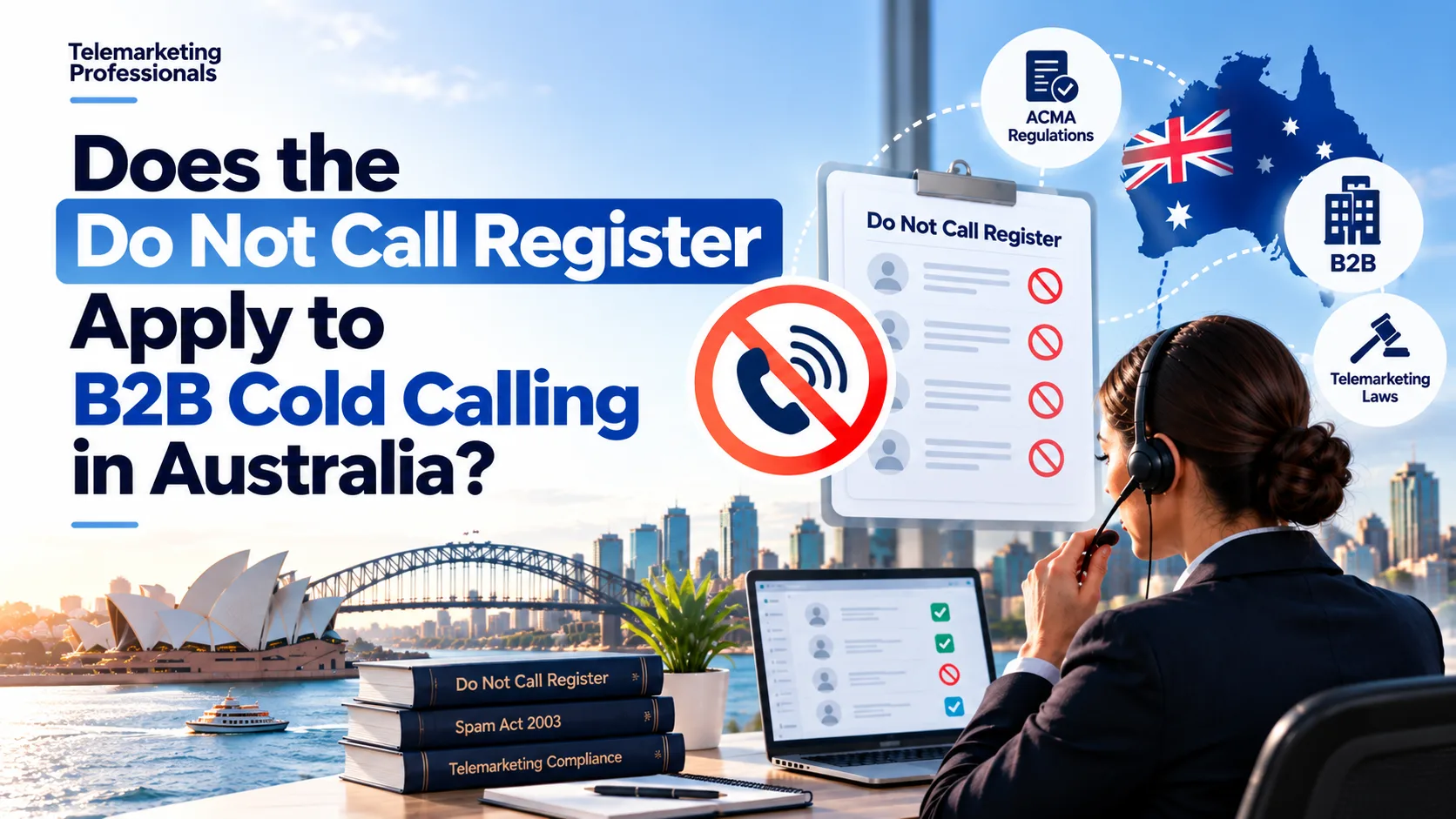
According to the Australian Communications and Media Authority (ACMA), business phone numbers cannot be added to Australia’s Do Not Call Register. However, where a phone is used for both personal and business purposes, it can be registered if personal use is more than 50% of its total use source: ACMA – Do Not Call Register
That gives genuine B2B prospecting more room to operate than many consumer telemarketing campaigns.
But it does not mean: B2B cold calling is completely unregulated in Australia.
Businesses also need to understand the Do Not Call Register Act 2006, the Telecommunications (Telemarketing and Research Calls) Industry Standard 2017, relevant privacy requirements, and, when email or SMS is involved, the Spam Act 2003.
The most useful way to understand the issue is:
“B2B” describes who you want to reach. It does not automatically determine the regulatory status of every phone number in your database.
Let’s break down what that means for Australian businesses.
What Is the Do Not Call Register in Australia?
The Do Not Call Register (DNCR) is an Australian Government service managed by ACMA.
Its purpose is to help people reduce unwanted telemarketing calls.
According to ACMA, eligible numbers include:
- home phone numbers
- personal mobile numbers
- fax numbers
Business phone numbers cannot be added to the Register. Once an eligible number has been on the Register for 30 days, telemarketers can generally only call where the person has given consent or an exemption applies. source: ACMA – How the Do Not Call Register Works
The underlying legislation is the Do Not Call Register Act 2006.
Official legislation: Federal Register of Legislation – Do Not Call Register Act 2006
Does the Do Not Call Register Actually Block Calls?
No This is an important distinction. Registering a number doesn’t create a technical barrier around the phone.
Someone can still physically dial the number.
ACMA explains that: The Register does not block calls. Instead, businesses can check their calling lists against the Register and remove registered numbers before making calls. Official source: ACMA – Do Not Call Register
This process is commonly known as list washing. So think of the DNCR as a regulatory system rather than a spam-call-blocking application.
Can Business Phone Numbers Be Registered on the Do Not Call Register?
This is the central issue for B2B prospecting.
ACMA’s current guidance is clear:
Business phone numbers cannot be added to the Do Not Call Register.
However, there’s an important qualification.
If someone uses the same phone for personal and business purposes, they can register the number when their personal use is more than 50% of total use.
Official source: ACMA – Do Not Call Register Eligibility
This distinction becomes extremely important when your B2B database contains mobile numbers.
Consider three examples.
Scenario 1: Company switchboard
You call: ABC Manufacturing Pty Ltd
Main Office: (02) XXXX XXXX
This is clearly a company contact number.
Scenario 2: Direct business number
You call: Operations Department
Direct Office: (03) XXXX XXXX
Again, this may clearly be maintained for business purposes.
Scenario 3: Managing Director’s mobile
Your CRM contains:
Name: David Smith
Company: ABC Logistics
Position: Managing Director
Mobile: 04XX XXX XXX
David is obviously a business decision-maker.
But his job title alone doesn’t establish whether that particular mobile is used primarily for business, primarily for personal use, or both.
That’s where businesses need to be more careful.
A Business Prospect Is Not Automatically a Business Phone Number
This is one of the most important points for modern B2B sales teams.
There are really two questions:
Who are we trying to contact?
and:
What type of phone number are we using to contact them?
They aren’t necessarily the same question.
Years ago, B2B cold calling often looked like this: Call reception → Ask for decision-maker → Get transferred.
Modern prospecting is different.
Sales databases can now contain:
- switchboards
- direct office lines
- company-issued mobiles
- personal mobiles
- mixed-use mobiles
- numbers from old CRMs
- numbers from prospecting databases
- numbers collected through previous interactions
That’s why a contact being labeled CEO, Managing Director or Head of Sales doesn’t by itself answer every DNCR question about their mobile number.
“We Bought a B2B Database” Isn’t Enough
Suppose a data provider sells you:
- 10,000 Australian companies
- 15,000 decision-makers
- 11,000 direct numbers
The spreadsheet is called: Australian_B2B_Leads.xlsx
Does that automatically establish that all 11,000 numbers should be treated identically? – No.
The database might contain:
- genuine business numbers
- company mobiles
- personal mobiles
- mixed-use numbers
- duplicate contacts
- outdated contacts
- disconnected numbers
- reassigned numbers
- contacts who have changed companies
- people who previously asked your business not to contact them
That’s why database quality isn’t only a sales issue.
It can also affect your compliance process.
Before launching a large telemarketing campaign, understand what’s actually inside your database.
Is B2B Cold Calling Legal in Australia?
B2B cold calling can be conducted in Australia, but businesses should interpret that as meaning there are no rules.
Australia has a regulatory framework covering different aspects of telemarketing.
Two particularly important parts are:
1. Do Not Call Register Act 2006
The Do Not Call Register Act 2006 contains rules concerning unsolicited telemarketing calls to numbers registered on the DNCR.
Section 11 deals specifically with unsolicited telemarketing calls to registered Australian numbers.
Official legislation: Federal Register of Legislation – Do Not Call Register Act 2006
2. Telecommunications (Telemarketing and Research Calls) Industry Standard 2017
This Standard establishes enforceable requirements concerning how telemarketing and research calls are conducted.
It covers areas including:
- permitted calling times
- caller identification
- calling line identification
- information provided during calls
- termination of calls
The Standard remains listed as in force on the Federal Register of Legislation.
Official legislation: Federal Register – Telecommunications (Telemarketing and Research Calls) Industry Standard 2017
Does the Telemarketing Industry Standard Apply to B2B Calls?
This is where the distinction becomes especially important.
The official Australian Do Not Call Register guidance says the Industry Standards apply to individuals and organizations making or arranging relevant telemarketing or research calls to Australian numbers, including numbers that are not on the Register.
Official source: Australian Government Do Not Call Register – Industry Standards
Therefore:
“This number isn’t on the DNCR” does not automatically mean “no telemarketing rules apply.”
The DNCR and the Industry Standard deal with related but different parts of the regulatory framework.
What Counts as a Telemarketing Call?
Another mistake is assuming that changing the internal name of a campaign changes what the call actually is.
Your CRM might call the campaign:
- Business Development
- Outbound Sales
- Lead Generation
- Prospecting
- SDR Outreach
or:
- Appointment Setting
But the purpose of the call matters.
The official DNCR Industry Standards guidance says the Telemarketing and Research Calls Industry Standard applies to voice calls to Australian numbers that, among other things:
- offer, advertise or promote goods or services
- promote business opportunities
- promote investment opportunities
- advertise or promote suppliers or prospective suppliers
- solicit donations
- conduct certain research or opinion polling
Official source: Australian Government DNCR – Industry Standards
So calling your campaign “business development” doesn’t automatically mean telemarketing requirements are irrelevant.
What Time Can Telemarketers Call in Australia?
The Industry Standard sets permitted calling periods.
For telemarketing calls, the general permitted periods are:
| Day | Telemarketing Calling Period |
| Monday–Friday | 9:00 am–8:00 pm |
| Saturday | 9:00 am–5:00 pm |
| Sunday | No calls |
| National public holidays | No calls |
These restrictions apply unless relevant consent allows calling at another time.
The official guidance also lists national public holidays for this purpose, including days such as Australia Day, Good Friday, Easter Monday, Anzac Day, Christmas Day and Boxing Day, including applicable days in lieu.
Official source: Australian Government DNCR – Permitted Calling Times
Legal Calling Hours Are Not Necessarily Good Sales Hours
There’s another side to this that isn’t about regulation.
Imagine calling a CFO at 7:45 pm.
Even if a particular call is within the permitted regulatory window, does that make 7:45 pm a good time to start discussing outsourced sales?
Probably not.
Compliance answers: When are we permitted to call?
Sales strategy asks: When is this prospect actually likely to have a useful conversation with us?
The two should work together.
A strong appointment setting campaign shouldn’t simply push calls to the edge of the legally permitted window.
It should identify when decision-makers are most likely to engage.
Australian Time Zones Matter
This becomes particularly important for national B2B campaigns.
Imagine your SDR team is based in Sydney but calls prospects across:
- Sydney
- Melbourne
- Brisbane
- Adelaide
- Perth
Your dialer shouldn’t simply treat every contact as being in Sydney.
Australia has multiple time zones, and daylight-saving differences add another layer.
The official Industry Standard also addresses situations where the person being called is at a location where the local time is outside permitted calling times.
Official source: Australian Government DNCR – Industry Standards
From a practical perspective, the safest operational approach is to configure calling activity around the prospect’s location and applicable local time.
Does Caller ID Need to Be Enabled?
Yes. The official Industry Standards guidance says a caller must ensure calling line identification (CLI) is enabled when they make or attempt to make a relevant call, or cause a call to be made.
The telephone number used for return contact must remain available for at least 30 days after the original call.
For telemarketing calls, when someone calls the displayed number back, they must be able to obtain information including:
- the name of the employer of the caller
- the purpose of the call
- who caused the call to be made
Official source: Australian Government DNCR – Calling Line Identification Requirements
This is why legitimate telemarketing shouldn’t be designed around hiding who is calling.
What Information Should a Caller Provide?
Transparency matters. Official DNCR guidance says callers must provide certain information during relevant telemarketing calls.
Consumer guidance specifically identifies information such as:
- the caller’s given name
- the business they’re calling from
- the business that caused the call to be made
- the purpose of the call
Additional business and complaint contact information may need to be provided when requested.
Official source: Australian Government DNCR – Telemarketing Caller Requirements
From a sales perspective, this also makes sense.
A prospect wants to understand:
- Who are you?
- Where are you calling from?
- Why are you calling me?
What Does a Poor B2B Cold Call Sound Like?
Consider: “Hi David, I’m just calling regarding your business. Have you got a minute?”
David immediately wonders:
- Who are you?
- What company?
- What is this about?
The salesperson has created suspicion before the conversation has even started.
Compare that with: “Hi David, Sarah calling from ABC Solutions. We work with Australian logistics businesses that are trying to improve their outbound sales pipeline. I wanted to understand how you’re currently handling prospecting.”
David may still say no.
That’s normal.
But at least he knows who is calling and why.
Good telemarketing isn’t about tricking somebody into staying on the phone.
It’s about giving the right prospect a credible reason to continue the conversation.
What Happens If Someone Says “End the Call”?
This is an area where the official requirements are clear.
The DNCR Industry Standards guidance states that a caller must terminate the call immediately where the recipient:
- asks for the call to be terminated, or
- otherwise indicates that they don’t want the call to continue.
There are also requirements concerning circumstances where the caller becomes aware that the recipient is at another location outside the permitted calling times.
Official source: Australian Government DNCR – Terminating a Call
This is an important distinction for sales teams.
If someone says: “I’m busy at the moment.”
it may be appropriate to ask: “No problem. Is there a better time?”
But: “Please end the call.” is different. That isn’t the moment for another objection-handling script.
What If Someone Says “Don’t Call Me Again”?
This information should be captured reliably.
A professional CRM process might include dispositions such as:
- Do Not Call
- Opted Out
- Wrong Number
- Wrong Contact
- Left Company
- Invalid Number
- Not Relevant
- Call Back Requested
- Existing Customer
- Qualified Lead
- Appointment Booked
Why?
- Because databases get reused.
- Imagine someone asks not to be contacted in February.
- In August, marketing purchases a new list.
- The same contact appears again.
If your team simply uploads the new CSV without checking existing suppression information, that person may receive another call.
Internally, you might consider it a new campaign.
From the prospect’s perspective: “I already told this company not to call me.”
This is why internal suppression and CRM hygiene should be part of the outbound process.
How Does DNCR List Washing Work?
The DNCR doesn’t physically prevent calls.
Instead, ACMA explains that businesses can check their calling lists so numbers on the Register can be removed before telemarketing calls are made.
Official source: ACMA – Do Not Call Register
For businesses running outbound campaigns, the practical question becomes:
Could this database contain numbers that are eligible for and registered on the DNCR?
That’s particularly relevant when working with old or mixed databases.
Does Every B2B Database Need to Be Treated the Same Way?
No. Imagine a CRM containing 30,000 contacts collected over eight years.
The numbers came from:
- website enquiries
- old customers
- purchased databases
- trade shows
- referrals
- business directories
- former salespeople
- data providers
- prospecting tools
- manual research
Would you confidently say every number is:
- Current?
- Accurate?
- Business-use?
- Appropriate for the campaign?
Probably not without reviewing the data.
That’s why the better question isn’t:
“Is this a B2B database?”
It’s: “What types of contact records and numbers are actually inside this database?”
Why Database Cleansing Should Come Before B2B Telemarketing
Consider two sales teams.
Team A: Volume First
They purchase 10,000 contacts on Monday.
On Tuesday, the CSV goes directly into the dialler.
During the first week, callers encounter:
- disconnected numbers
- duplicates
- wrong contacts
- people who left years ago
- irrelevant businesses
- old job titles
- questionable mobile numbers
- previous opt-outs
At the end of the week, management reports:
“We made 2,000 calls.”
But how many of those calls had a realistic chance of becoming a sales opportunity?
Team B: Data First
The second company cleans the database first.
It:
- removes duplicates
- validates companies
- checks decision-makers
- identifies obviously outdated records
- applies internal suppression information
- segments businesses by industry
- segments by company size
- prioritizes the strongest accounts
- prepares messaging around relevant business problems
They may make fewer calls.
But they have more relevant conversations.
That’s why database cleansing is part of effective B2B lead generation, not simply an administrative exercise.
Can You Buy a B2B Database and Start Calling?
A purchased database shouldn’t automatically be treated as campaign-ready.
Before calling, ask:
Where did the data come from?
Understand the source.
When was it last verified?
- People change jobs.
- Businesses close.
- Telephone numbers get disconnected or reassigned.
What types of numbers are included?
Are they:
- switchboards?
- office lines?
- business mobiles?
- personal mobiles?
- mixed-use numbers?
Has the list been checked against your own suppression records?
A data provider won’t necessarily know that someone asked your organization not to contact them previously.
Does the database match your ICP?
This is equally important commercially.
If your ideal customer is an Australian technology company with 50–500 employees, calling thousands of unrelated micro businesses isn’t a good strategy simply because their phone numbers are available.
Does Australian Privacy Law Matter for B2B Prospecting?
Potentially. A B2B database can still contain personal information relating to identifiable individuals.
Consider:
Company: ABC Manufacturing Pty Ltd
Name: David Smith
Position: Operations Director
Mobile: 04XX XXX XXX
Email: david@example.com.au
Previous interaction: Called June 2026
The company is an organization.
David is an individual.
The Office of the Australian Information Commissioner (OAIC) explains that Australian Privacy Principle 7 applies to organizations using or disclosing personal information for direct marketing, although APP 7 doesn’t apply to the extent that a direct marketing communication is covered by the DNCR Act or Spam Act.
Official source: OAIC – Direct Marketing and Privacy
For a more detailed explanation of how APP 7 interacts with other legislation:
Official source: OAIC – APP 7 Direct Marketing Guidelines
The practical lesson is simple:
Data compliance begins before the phone rings.
Businesses should think about how prospect information is collected, stored, managed and used.
Does the Spam Act Apply to B2B Cold Calling?
Ordinary voice telemarketing calls and commercial electronic messages sit under different regulatory frameworks.
The Spam Act 2003 deals with commercial electronic messages such as marketing email and SMS.
ACMA’s current guidance says businesses sending marketing emails or messages need to understand requirements around:
- consent
- identifying the sender
- providing contact information
- providing a functional unsubscribe mechanism
Official source: ACMA – Avoid Sending Spam
This distinction matters because modern B2B lead generation is usually multichannel.
For example:
Day 1: Email
Day 3: LinkedIn activity
Day 5: Phone call
Day 8: Email follow-up
Day 12: Second call
Don’t assume: “If we can make the phone call, every other part of the sequence is automatically okay.”
Different channels need to be assessed under the requirements that apply to them.
Can You Send Cold Emails to B2B Prospects?
This needs to be assessed separately from telephone prospecting.
ACMA states that if you plan to send marketing messages or emails, you need consent from the recipient.
After obtaining consent, the message must:
- identify the sender
- contain contact details
- make it easy to unsubscribe
ACMA also explains the different forms of consent and the rules around unsubscribe requests.
Official source: ACMA – Australian Spam Rules
Importantly, outsourcing the sending doesn’t make this disappear.
ACMA says businesses need consent even when someone else sends the marketing messages on their behalf.
So phone outreach and email outreach shouldn’t simply be placed into one automation without considering the requirements of each channel.
What If You Outsource B2B Telemarketing?
This is particularly important for companies using:
- telemarketing agencies
- appointment setting providers
- outsourced SDR teams
- call centers
- overseas calling teams
Businesses shouldn’t assume:
“The agency makes the calls, so compliance is entirely their problem.”
The Do Not Call Register Act 2006 doesn’t only deal with making telemarketing calls; it also contains provisions relating to causing calls to be made.
Official legislation: Federal Register – Do Not Call Register Act 2006
The official DNCR Industry Standards also state that the requirements apply to individuals or organizations that make or arrange for telemarketing calls to be made.
Official source: Australian Government DNCR – Industry Standards
The practical lesson is:
Outsourcing the calls doesn’t mean outsourcing your understanding of the campaign.
What Should You Ask an Outsourced Telemarketing Provider?
Don’t only ask:
- How much do you charge?
- How many calls will you make?
- How many meetings will you book?
Also ask:
- Where does the prospect data come from?
- How do you validate telephone numbers?
- How do you manage DNCR requirements?
- How do you identify potentially personal or mixed-use numbers?
- How do you manage Australian calling times?
- How do you handle different Australian time zones?
- Is CLI enabled?
- How do callers identify themselves?
- How are do-not-call requests recorded?
- How are internal suppression records maintained?
- How are callers trained?
- How are complaints handled?
- Can campaign activity be audited?
- How are call outcomes recorded in the CRM?
The cheapest calling rate isn’t necessarily the cheapest sales solution.
Poor data, poor targeting, and poor processes can cost considerably more in wasted time and damaged reputation.
What About Overseas Call Centers?
The official DNCR Industry Standards apply to organizations that make or arrange relevant telemarketing calls to Australian numbers.
Official source: Australian Government DNCR – Industry Standards
So Australian businesses shouldn’t assume that using an offshore provider makes Australian telemarketing requirements irrelevant.
Offshore campaigns can also introduce additional operational challenges:
- Australian time zones
- public holidays
- caller identification
- caller training
- CRM access
- data handling
- quality assurance
- complaint escalation
- local market knowledge
These processes should be established before the campaign starts.
What Happens If You Break Australian Telemarketing Rules?
Telemarketing compliance shouldn’t be treated as a box-ticking exercise.
There can be real consequences when Australian businesses make telemarketing calls that don’t comply with applicable requirements.
The Australian Communications and Media Authority (ACMA) is responsible for monitoring and enforcing Australia’s spam and telemarketing laws.
Where ACMA identifies breaches, its enforcement options can include:
- formal warnings
- infringement notices
- court-enforceable undertakings
- Federal Court proceedings
- significant financial penalties
Official source: ACMA – Investigations into Spam and Telemarketing
This is important because telemarketing breaches don’t necessarily become an issue only when one salesperson makes one bad call.
Problems can become much more serious when a weak process is repeated across hundreds or thousands of outbound calls.
Can ACMA Fine Businesses for Telemarketing Breaches?
Yes. The Do Not Call Register Act 2006 contains civil penalty provisions, and ACMA can also issue infringement notices in circumstances provided for by the legislation.
The Federal Register of Legislation sets out the civil penalty framework under the Act, including provisions covering civil penalty orders and maximum penalties.
Official legislation: Federal Register of Legislation – Do Not Call Register Act 2006
ACMA also confirms that infringement notices can be issued under the Do Not Call Register Act.
Official source: ACMA – Infringement Notices
The exact financial exposure can depend on the particular provision breached, the number and nature of contraventions, prior conduct and other circumstances.
That’s why businesses should be careful about relying on a single dollar figure copied from an old article. Penalty units and legislation can change.
The more important point for a sales or marketing team is this:
One weak telemarketing process can potentially create repeated breaches when it is applied across a large database.
What Can ACMA Actually Do?
ACMA says that where it finds breaches of spam or telemarketing laws, it can take several forms of enforcement action.
These include:
Issue a formal warning
For some compliance issues, ACMA can formally warn the organization.
Issue an infringement notice
An infringement notice can require a business to pay a financial penalty.
Accept a court-enforceable undertaking
A business may be required to commit to specific compliance improvements.
This can go considerably further than simply paying a penalty.
For example, an undertaking may require changes to compliance systems, processes, monitoring or reporting.
Take the matter to the Federal Court
ACMA can also take matters to the Federal Court, where significant civil penalties may be imposed.
Official source: ACMA – Investigations into Spam and Telemarketing
So the risk isn’t simply:
“We might receive a complaint.”
A serious or systemic compliance failure can potentially become a regulatory investigation.
Do Australian Businesses Actually Get Penalised for Telemarketing Breaches?
Yes.
These aren’t theoretical powers that exist only in legislation.
ACMA publishes the outcomes of its spam and telemarketing investigations.
One recent example is particularly useful for understanding the scale of the risk.
TAB – 2026 Telemarketing Enforcement
In July 2026, ACMA announced enforcement action against Tabcorp Holdings Limited (TAB) relating to telemarketing and spam breaches.
According to ACMA, the telemarketing issues included calls to numbers on the Do Not Call Register without consent, calls during prohibited times and failures to provide required information at the start of calls.
ACMA’s published investigation outcomes record a $1,504,800 infringement notice relating to telemarketing, together with an enforceable undertaking.
Official source: ACMA – Investigations into Spam and Telemarketing
ACMA also reported broader spam and telemarketing penalties involving TAB and stated that businesses had paid more than $12 million in penalties for spam and telemarketing breaches over the previous 18 months at the time of its July 2026 announcement.
Official source: ACMA – TAB Pays $2.7 Million for Telemarketing and Spam Breaches
The lesson for ordinary Australian businesses isn’t that every telemarketing mistake will result in a million-dollar penalty.
It’s that ACMA actively investigates and enforces these rules.
Smaller Businesses Have Faced Enforcement Too
Enforcement isn’t limited to Australia’s largest companies.
ACMA’s published records include previous telemarketing actions such as:
Information Support Australia Pty Ltd — a $102,120 infringement notice and enforceable undertaking in 2021 relating to telemarketing calls to numbers on the Do Not Call Register without consent.
Kalkine Pty Limited — a $251,400 infringement notice and enforceable undertaking in 2021 relating to calls to registered numbers without consent.
The Wine Group Pty Ltd — a $200,000 infringement notice in 2022 involving spam and telemarketing issues, including calls to registered numbers without consent, not ending calls immediately when asked and not providing required information to recipients upon request.
Green Sales Pty Ltd — a $50,400 infringement notice in 2020 involving calls to registered numbers without consent, failures to end calls when requested and failures to provide required information at the beginning of calls.
Official source: ACMA – Infringement Notices
These examples highlight something important.
Telemarketing compliance isn’t only about checking whether a telephone number appears on the DNCR.
Enforcement can involve how the call itself is conducted.
That includes issues such as:
- calling registered numbers without appropriate consent
- calling outside permitted times
- failing to identify the caller appropriately
- failing to provide required information
- failing to end the call when requested
How Does ACMA Decide Whether to Investigate?
Not every complaint automatically becomes a major Federal Court case.
ACMA says its compliance activities depend on factors including the risk of harm and impact on consumers.
Its actions can include:
- providing compliance information
- contacting businesses when complaints are received
- investigating serious or ongoing problems
- taking enforcement action where warranted
ACMA obtains information from sources including complaints, reports, industry feedback and other regulators.
Official source: ACMA – Action on Scams, Spam and Telemarketing
This means repeated complaints or systemic problems can be considerably more serious than an isolated operational mistake.
For B2B sales teams, that is another reason to have a process for identifying and fixing problems early.
Having a Telemarketing Compliance Policy Is Not Enough
This is one of the most practical lessons for any business running outbound campaigns.
You can have a document called:
“Telemarketing Compliance Policy.pdf”
sitting in Google Drive.
That doesn’t necessarily mean your telemarketing operation is well controlled.
The real question is: What happens when an SDR actually makes the call?
The Do Not Call Register Act itself recognises the importance of reasonable precautions and due diligence in relation to certain contraventions.
Official legislation: Federal Register – Do Not Call Register Act 2006
This is where compliance becomes operational rather than theoretical.
A business should be able to demonstrate that its procedures are actually being implemented.
What Does a Practical Telemarketing Compliance System Look Like?
A useful compliance system shouldn’t only tell employees:
“Follow Australian telemarketing laws.”
It should make compliance part of the actual outbound workflow.
1. Document Where Your Calling Data Comes From
Your business should know whether prospects came from:
- your CRM
- purchased databases
- website enquiries
- events
- referrals
- data providers
- public business information
- previous customers
- prospecting platforms
If nobody knows where a telephone number came from, assessing how it should be used becomes more difficult.
2. Review the Database Before Dialing
Don’t give callers an untouched CSV and tell them to start calling.
Before launching a campaign, check:
- duplicates
- invalid numbers
- outdated contacts
- previous opt-outs
- incorrect companies
- departed employees
- number types
- relevant suppression records
The goal isn’t only compliance.
Clean data also improves sales productivity.
3. Build DNCR Checking Into the Workflow
Where applicable, DNCR checking should happen before the relevant calls are made.
ACMA explains that the Register allows businesses to check calling lists and remove registered numbers before telemarketing calls.
Official source: ACMA – Do Not Call Register
Don’t rely on an SDR remembering which numbers might be registered.
The process should happen at the database or campaign level.
4. Configure Calling Hours in the Dialler
Don’t rely entirely on individual callers to remember:
“It’s too early in Perth.”
Where possible, your dialer or CRM should restrict calling according to:
- prospect location
- applicable time zone
- permitted calling periods
- relevant public holidays
The official Industry Standards specify the permitted telemarketing calling periods.
Official source: Australian Government DNCR – Industry Standards
Technology should help prevent avoidable mistakes.
5. Train Callers on Identification Requirements
A script shouldn’t simply be designed to maximize the number of people who stay on the phone.
Callers need to understand what information must be provided and when.
They should know:
- how to introduce themselves
- which business they represent
- who caused the call to be made where relevant
- how to explain the purpose of the call
- what additional information must be supplied if requested
Official source: ACMA – Dealing With Telemarketing
This can also improve the quality of the conversation because the prospect isn’t trying to work out who is calling them.
6. Train Callers to Recognize When the Conversation Is Over
Sales training often teaches objection handling.
That’s useful.
But compliance training needs to teach callers that not every objection should be overcome.
There is a difference between:
“I’m busy.”
and:
“Stop calling me.”
There is also a difference between:
“I’m not sure this is relevant.”
and:
“Please end the call.”
ACMA’s guidance says telemarketers must end the call when the recipient asks them to or indicates they don’t want the conversation to continue.
Official source: ACMA – Dealing With Telemarketing
Your team should understand that distinction.
7. Make Opt-Outs Easy to Record
Your CRM should make it easy for a caller to record:
DO NOT CALL
- immediately.
- Not after the shift.
- Not in a separate spreadsheet.
- Not in the caller’s personal time.
That record should then flow into the organisation’s suppression process so the same person isn’t accidentally added to another campaign later.
8. Monitor Calls
Training once isn’t enough.
Businesses should periodically review what actually happens on calls.
That might involve:
- listening to recorded calls where lawful and appropriate
- reviewing scripts
- checking CRM dispositions
- checking complaints
- reviewing caller introductions
- identifying repeated issues
- coaching callers
The purpose isn’t simply to catch employees making mistakes.
It is to identify whether the process itself is creating those mistakes.
If five different callers make the same error, the problem might be the training, script or system—not five individual employees.
9. Keep Useful Records
If someone complains three months after receiving a call, can your business establish what happened?
Useful records can include:
- campaign
- telephone number
- date
- time
- caller
- data source
- call outcome
- opt-out status
- callback request
- applicable list-checking information
- complaint notes
Good records make it easier to investigate problems internally.
10. Review Outsourced Providers
If another company makes calls on your behalf, don’t treat the provider as a black box.
Ask for visibility into:
- data sources
- calling processes
- scripts
- DNCR procedures
- caller training
- call outcomes
- suppression processes
- complaints
- quality assurance
The Do Not Call Register Act 2006 specifically contains requirements concerning agreements for making telemarketing calls and compliance with the Act.
Official legislation: Federal Register – Do Not Call Register Act 2006
A contract saying:
“Supplier must comply with all applicable laws”
shouldn’t be the beginning and end of your oversight.
Why “We Didn’t Know” Is a Poor Telemarketing Strategy
Imagine a sales manager discovers that a campaign has been making inappropriate calls for three weeks.
The explanation is: “We didn’t know those numbers were on the list.” Or: “The agency gave us the data.” Or: “The new SDR didn’t understand the rules.” Or: “Our dialer didn’t account for the time zone.”
These explanations may help identify why something went wrong. But they also highlight weaknesses in the process. The Do Not Call Register Act 2006 includes provisions concerning reasonable precautions and due diligence in avoiding certain contraventions. Official legislation: Do Not Call Register Act 2006
That’s why a stronger approach is: Don’t build a telemarketing process that depends on nobody ever making a mistake. Build a process that makes common mistakes harder to make.
What Should a Sales Manager Check Every Month?
A simple monthly compliance review can look at:
- Data: Are new lists coming from approved sources?
- DNCR: Are relevant checking processes working?
- Calling times: Are any calls being placed outside permitted periods?
- Caller identification: Are callers giving the required information?
- CLI: Is the correct return number being displayed?
- Termination: Are calls being ended appropriately when requested?
- Suppression: Are do-not-call requests being honored?
- Complaints: Are the same issues appearing repeatedly?
- Training: Do new SDRs understand the process?
- Providers: Are outsourced agencies following the agreed process?
The goal isn’t to create unnecessary bureaucracy. It’s to catch a small problem before it becomes a campaign-wide problem.
The Bigger Lesson for B2B Telemarketing
Good compliance isn’t just about avoiding a penalty.
It usually points towards a better sales operation as well.
Think about what a well-controlled telemarketing campaign requires:
- Accurate data.
- Clear targeting.
- Trained callers.
- Transparent introductions.
- Good CRM records.
- Respect for prospect preferences.
- Consistent follow-up.
- Quality assurance.
Those are also characteristics of a good B2B appointment setting campaign.
So compliance shouldn’t sit in a separate folder that anybody opens.
It should be built into the sales process itself.
Target → Validate → Check → Call → Qualify → Record → Suppress where required → Review → Improve.
That creates a much stronger foundation for sustainable B2B lead generation.
B2B vs B2C Telemarketing in Australia
There are important differences between B2B and consumer telemarketing, but it would be inaccurate to simplify them to:
- B2B = unregulated
- B2C = regulated
A better comparison is:
| Area | B2B Telemarketing | B2C Telemarketing |
| Typical target | Businesses/decision-makers | Consumers |
| Genuine business phone numbers | Cannot be added to DNCR | Eligible personal numbers may be registered |
| Mixed-use numbers | Need careful assessment | Can be eligible depending on use |
| Industry Standard | Can apply | Can apply |
| Calling times | Apply to relevant calls | Apply |
| Caller identification | Required for relevant calls | Required |
| CLI requirements | Apply | Apply |
| Database cleansing | Important | Important |
| Suppression management | Important | Important |
| Privacy considerations | Can apply | Can apply |
| Email/SMS | Separate Spam Act considerations | Separate Spam Act considerations |
For the official distinction between business, personal, and mixed-use numbers: Source: ACMA – Do Not Call Register
Compliance Is More Than Checking the DNCR
This is perhaps the most important takeaway for Australian businesses.
A professional telemarketing process isn’t simply: Upload database → Wash list → Start dialing.
It should consider: Data source : Where did the contact information come from?
- Number type : Is the number clearly business-use, potentially personal, mixed-use or uncertain?
- DNCR : Could eligible registered numbers be present?
- Calling times : Are calls being made during permitted periods?
- Time zones : Are you considering the recipient’s location?
- Caller identification : Does the recipient understand who’s calling?
- Calling line identification : Is an appropriate return number displayed?
- Call termination : Do callers know when the conversation must end?
- Suppression : Can previous do-not-contact requests be recognized in future campaigns?
- Training : Do callers understand the campaign and the rules governing it?
- Record keeping : Can you reconstruct what happened if a complaint arises?
A Practical Australian B2B Telemarketing Checklist
Before launching an outbound campaign, work through these areas.
Database
- Do we know where the contact information came from?
- Is the information current?
- Have duplicates been removed?
- Have departed employees been identified?
- Have previous suppression records been applied?
- Do we understand what types of telephone numbers are included?
DNCR
- Could the database contain DNCR-eligible numbers?
- Have we reviewed the applicable DNCR requirements?
- Do we need to check relevant numbers against the Register?
- Can we demonstrate the process we followed?
Calling process
- Are permitted calling periods configured?
- Are Australian time zones accounted for?
- Is calling line identification enabled?
- Can recipients return the call?
- Do callers know what information they need to provide?
- Do callers know when a call must be terminated?
CRM
- Can callers record do-not-call requests?
- Are suppression records centrally maintained?
- Are call outcomes recorded?
- Are callback requests recorded?
- Will future campaigns recognize previous requests?
Outsourcing
- Does the provider understand Australian telemarketing requirements?
- Are responsibilities documented?
- Do we understand how prospect data is handled?
- Are callers trained?
- Is campaign activity auditable?
Multichannel outreach
- Have email activities been assessed separately?
- Have SMS activities been assessed separately?
- Have applicable Spam Act requirements been considered?
- Have privacy obligations been considered?
Why Better Compliance Can Improve Appointment Setting Results
Compliance and sales performance aren’t necessarily competing priorities.
Many of the processes that support responsible telemarketing also improve sales performance.
Cleaner data means fewer wasted calls
Your SDRs spend less time calling disconnected numbers and outdated contacts.
Better targeting means better conversations
The prospect is more likely to understand why you’re contacting them.
Transparent introductions create trust
Decision-makers know who they’re speaking with and why.
Better CRM records improve follow-up
Your team knows what happened during previous conversations.
Suppression protects your brand
People who clearly don’t want contact aren’t unnecessarily approached again.
Better qualification improves appointment quality
Your account executives spend more time speaking with genuine opportunities.
That’s why the success metric shouldn’t simply be:
“We made 1,000 calls this week.”
Ask instead:
- How many decision-makers did we reach?
- How many meaningful conversations did we have?
- How many contacts actually matched our ICP?
- How many qualified appointments did we book?
- How many meetings became opportunities?
- How much pipeline did the campaign create?
Those metrics tell you far more about the quality of your B2B lead generation.
Where Does B2B Appointment Setting Fit?
Most complex B2B products and services aren’t sold during the first cold call. Also, they shouldn’t need to be. The initial conversation is usually about understanding whether there’s enough relevance to justify a deeper discussion.
The caller needs to establish:
- Is this the right company?
- Is this the right decision-maker?
- Is there a relevant business problem?
- Does our solution potentially fit?
- Is the timing reasonable?
- Would a deeper conversation be worthwhile?
If the answer is yes, the next step is a qualified appointment.
That’s the difference between: Cold calling for volume and B2B appointment setting for pipeline.
A mature outbound process looks more like: ICP → Prospect research → Database cleansing → Compliance checks → Calling → Qualification → Follow-up → Appointment → Opportunity
This also allows account executives to spend more of their time on:
- discovery calls
- demonstrations
- solution development
- proposals
- negotiation
- closing
rather than spending half their week looking for people to call.
Is B2B Cold Calling Still Effective in Australia?
It can be, particularly when targeting and data quality are strong.
Not every potential buyer is actively searching Google for your service today.
Some companies:
- don’t know your business exists
- aren’t actively searching yet
- already work with a competitor
- have a contract approaching renewal
- are planning a project internally
- recognize a problem but haven’t prioritized solving it
- have visited your website without contacting you
Inbound marketing waits for these prospects to take action.
Outbound prospecting allows you to start the conversation.
That’s where B2B telemarketing and appointment setting can add value.
But there’s a major difference between:
“We have 20,000 phone numbers.”
and:
“We have identified 1,000 Australian companies that fit our ICP and we know why our offer may be relevant to them.”
The second is a strategy.
The first is just a database.
Final Answer: Does the Do Not Call Register Apply to B2B Cold Calling in Australia?
Here’s the practical answer.
According to ACMA, business phone numbers cannot be added to Australia’s Do Not Call Register.
Where a phone is used for both business and personal purposes, it may be registered where personal use is more than 50% of total use.
Official source: ACMA – Do Not Call Register
However, this does not mean B2B cold calling is completely outside Australian telemarketing regulation.
The Telecommunications (Telemarketing and Research Calls) Industry Standard 2017 applies to relevant telemarketing calls to Australian numbers, including numbers that aren’t on the Register.
Official source: Australian Government DNCR – Industry Standards
Businesses therefore need to think about:
- what type of number they’re calling
- where the contact data came from
- whether DNCR requirements apply
- permitted calling times
- caller identification
- calling line identification
- call termination requests
- internal suppression
- database quality
- privacy considerations
- outsourced telemarketing arrangements
- separate email and SMS requirements
The objective shouldn’t be:
“How many numbers can we legally dial?”
The better question is:
“How do we build a targeted, professional and responsible outbound process that creates more qualified sales conversations?”
That means:
Better data → Better targeting → Better compliance processes → Better conversations → Better appointments → Better pipeline.
At Telemarketing Professionals, we help Australian businesses build structured campaigns across B2B telemarketing, appointment setting, lead generation, outsourced SDR support and database cleansing, with the focus on creating meaningful sales conversations rather than simply increasing call volume.
ACMA says business phone numbers cannot be added to the DNCR. However, mixed business/personal numbers can be eligible where personal use exceeds 50% of total use. Source: ACMA – Do Not Call Register
B2B cold calling can be conducted in Australia, but applicable telemarketing requirements still need to be considered. In particular, the Industry Standard establishes rules governing relevant telemarketing calls to Australian numbers.
Source: Australian Government DNCR – Industry Standards
Yes. Official DNCR guidance says the Industry Standards apply to organisations making or arranging relevant telemarketing/research calls to Australian numbers, even those not on the Register.
Source: DNCR – Industry Standards
General telemarketing calling periods are 9:00 am–8:00 pm Monday to Friday and 9:00 am–5:00 pm Saturday. Telemarketing calls aren’t permitted on Sundays or national public holidays unless applicable consent changes the position.
Source: DNCR – Permitted Calling Times