
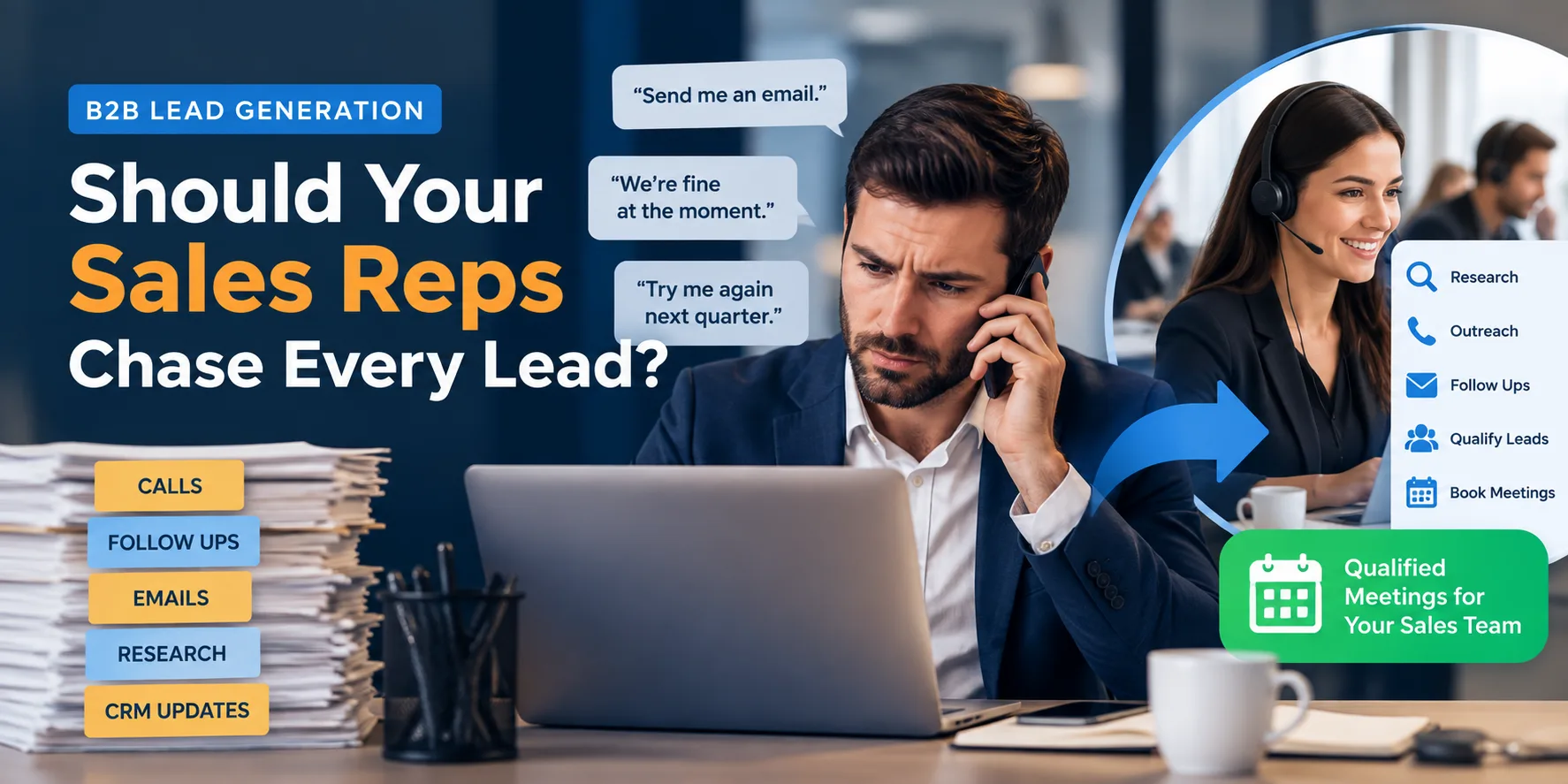
Your sales rep finally reaches the right decision-maker.
The conversation starts well. The prospect listens, asks a question or two, and then says:
“Sounds interesting. Send me an email.”
Your rep sends the email.
Two days later, there is no response. They call again. No answer. Another follow-up email goes out. A reminder is added to the CRM. Perhaps they try again the following week.
One prospect does not sound like much work.
But what happens when your team hears “send me an email” from 50, 100 or 500 prospects?
This is a common but often overlooked B2B lead generation problem. The issue isn’t that prospects want information by email. The issue is the amount of sales time required to turn early interest into a qualified conversation.
If experienced salespeople are spending hours researching contacts, making first-touch calls, sending introductory emails, and repeatedly following up, businesses need to ask a practical question:
Is this the best use of their time, or could an outsourced SDR function handle the early-stage work more efficiently?
The answer depends on the business. But comparing the two models requires looking beyond salary or monthly service fees and considering the full cost of generating a qualified sales opportunity.
Why Is “Send Me an Email” a B2B Lead Generation Problem?
“Send me an email” can mean many things.
The prospect might genuinely want more information. They may be busy when the call arrives. They might need something to share with another decision-maker. They may be interested but not ready to have a detailed conversation.
Or they may simply be trying to end an unexpected sales call politely.
A good salesperson cannot assume which one applies.
That means the prospect still needs to be qualified.
Instead of simply responding:
“Sure, I’ll send something through.”
the rep might ask:
“Absolutely. Just so I can send you something relevant, are you currently handling all of your prospecting internally?”
One additional question can change the quality of the follow-up.
Perhaps the prospect has an internal SDR team. Perhaps their account executives do all their own prospecting. Maybe they rely almost entirely on referrals.
Now the follow-up email has context.
This is the difference between simply sending emails and running a structured B2B lead generation process.
How Much Sales Time Does B2B Lead Generation Really Consume?
Consider what happens before a qualified appointment reaches the calendar.
Someone may need to:
- identify target companies;
- find appropriate decision-makers;
- verify contact information;
- make initial calls;
- send introductory emails;
- handle gatekeepers;
- leave voicemails;
- record call outcomes;
- schedule callbacks;
- follow up on requested information;
- qualify potential opportunities;
- update the CRM;
- and finally arrange the meeting.
All of those activities matter.
But only some require the skills of an experienced salesperson.
This distinction matters because Salesforce’s sales research has repeatedly shown that sales professionals spend a large part of their working time on activities other than direct selling.
For a business, this creates an opportunity-cost question.
If a salesperson spends ten hours prospecting this week, that is ten hours they cannot simultaneously spend conducting discovery meetings, developing proposals, negotiating or progressing active opportunities.
The hidden cost of B2B lead generation therefore isn’t only what you pay for leads.
It can also be the selling capacity consumed while finding and qualifying them.
Are Your Sales Reps Prospecting More Than They Are Selling?
Picture a Monday morning for an experienced business development manager.
- They start with a list of 30 target companies.
- Several contacts have changed jobs.
- A few phone numbers are incorrect.
- Some prospects don’t answer.
- Reception redirects several calls.
One decision-maker says:
- “We’re fine at the moment.”
Another says:
- “Try me again next quarter.”
Two say:
“Send me an email.”
By lunchtime, your salesperson has been extremely busy.
But how much actual selling has taken place?
This isn’t an argument against prospecting. Without prospecting, many businesses would eventually struggle to maintain pipelines.
The question is whether your highest-value salespeople need to perform every stage of that process personally.
That’s where separating prospecting from closing becomes important.
Where Does an SDR Fit Into the B2B Lead Generation Process?
An SDR — Sales Development Representative — generally works at the earlier stages of the sales process.
A simplified model looks like this:
Targeting → Prospecting → Outreach → Follow-Up → Qualification → Appointment Setting → Sales
The SDR concentrates on creating and qualifying conversations.
The account executive, business development manager or sales closer takes over once there is a sufficiently relevant opportunity.
This means your experienced salesperson doesn’t necessarily need to spend their morning calling 30 cold prospects to find two people willing to continue the conversation.
The SDR does that work.
The sales team becomes involved when their skills can create greater value.
An outsourced SDR applies the same principle without requiring the business to recruit and build the complete function internally.
What Happens After a B2B Prospect Says “Send Me an Email”?
This is where a structured SDR process becomes valuable.
Imagine the following conversation:
Prospect: “Send me some information.”
SDR: “Absolutely. Before I do, are you currently generating most of your new business through your internal sales team?”
Prospect: “Yes. Our account managers do most of their own prospecting.”
That one answer creates useful context.
Instead of sending a generic company brochure, the SDR can send information relevant to the prospect’s situation.
The process might then look like this:
Day 1: Conversation takes place and relevant information is sent.
Day 3: SDR follows up.
No answer.
Day 6: Another appropriate contact attempt is made.
This time, the prospect answers:
“Yes, I saw it. We’re actually looking at how we generate new business because our salespeople are spending too much time prospecting.”
Now the conversation has changed.
The SDR can ask additional qualification questions.
If there is a genuine requirement and the company fits the target profile, an appointment can be arranged.
The internal salesperson now enters the conversation with context.
That’s disparate from: Cold call → Send brochure → Hope the prospect replies.
Why B2B Lead Generation Needs More Than Email Follow-Ups
Email is useful, but relying entirely on email creates limitations.
Decision-makers have crowded inboxes. A relevant message can still be missed, forgotten, or postponed.
Simultaneously, repeated cold calls without context can become frustrating for prospects.
This is why modern B2B lead generation often works better as a coordinated process rather than a single-channel activity.
- A prospect might first receive an email.
- Another may be reached by phone.
- A third may speak with an SDR and request information.
- The important point is that each interaction informs the next one.
For example:
“Hi Sarah, we spoke on Tuesday, and I sent through the information you requested. You mentioned your sales team currently handles its own prospecting. I wanted to see whether reducing that workload is something you’re actively looking at.”
That is a very different conversation from another completely cold call.
The prospect knows why you are contacting them.
How Does Outsourced SDR Support Improve B2B Appointment Setting?
Outsourced SDR support can provide dedicated resources for the work that happens before a qualified sales meeting.
Depending on the campaign and provider, that may include:
- Prospecting: Identifying target companies and relevant contacts.
- Initial outreach: Starting conversations through agreed channels.
- Follow-up: Managing prospects who are not immediately ready for a meeting.
- Lead qualification: Establishing whether there is a relevant problem, fit, interest and timeframe.
- CRM management: Recording notes, outcomes and future actions.
- B2B appointment setting: Arranging meetings when the prospect meets agreed qualification criteria.
This can reduce the amount of early-stage activity handled directly by internal salespeople.
However, outsourcing should not mean completely disconnecting the external SDR team from your internal sales operation.
Good results require alignment.
The SDR team needs to understand your ideal customer profile, proposition, target decision-makers, common objections and what your business considers a genuinely qualified appointment.
Can Outsourced SDR Support Reduce B2B Lead Generation Costs?
It can in some situations, but businesses should avoid assuming outsourcing is automatically cheaper.
The correct comparison is total cost versus commercial output.
The Hidden Cost of an Internal SDR Team
An internal SDR doesn’t only create a salary expense.
Depending on the business and employment model, the total operating cost may also include:
- recruitment
- onboarding
- employer on-costs
- training
- management
- CRM licenses
- prospecting databases
- calling software
- sales engagement platforms
- email infrastructure
- reporting
- quality assurance
- leave
- employee turnover and replacement.
A business that already has the required infrastructure and management expertise may be able to operate an internal SDR team efficiently.
For another business starting from scratch, the economics may look very different.
An outsourced provider may already have some of the people, processes and infrastructure required to run prospecting campaigns.
Businesses should confirm exactly what is included before making a cost comparison.
Calculate Cost per Qualified Appointment, Not Cost per Call
Imagine an internal SDR operation has a total relevant monthly cost of $10,000.
It produces ten qualified, attended appointments.
A simplified calculation would be:
$10,000 ÷ 10 = $1,000 per qualified appointment.
Now imagine an outsourced SDR campaign costs $8,000 and generates eight equivalent appointments.
$8,000 ÷ 8 = $1,000 per qualified appointment.
Based on this metric, neither model is cheaper.
But even this comparison doesn’t tell the complete story.
Suppose six meetings from one campaign progress into genuine sales opportunities while only two from the other do.
The economics change again.
That’s why businesses should look beyond activity metrics.
These figures are illustrative examples only and are not industry pricing or performance benchmarks. Actual costs and results depend on the market, proposition, targeting, sales cycle, data quality, and qualification criteria.
B2B Appointment Setting Should Focus on Quality, Not Calendar Volume
Booking meetings is relatively meaningless if the wrong people attend them.
Imagine an SDR books 25 appointments in one month.
That number sounds impressive.
But then you discover:
- 10 prospects don’t attend.
- Five companies are too small for your service.
- Four contacts have no decision-making influence.
- Three have no relevant requirement.
- Suddenly, the original number doesn’t look as useful.
This is why B2B appointment setting should be measured by more than appointments booked.
Businesses should also examine:
- Attendance rate – Did the prospect actually attend?
- Qualification – Did the prospect match the agreed criteria?
- Opportunity rate – Did the meeting become a genuine sales opportunity?
- Pipeline generated – What potential commercial value entered the pipeline?
The objective isn’t to create the busiest calendar.
It is to create sales conversations worth having.
Internal SDR vs Outsourced SDR: What Should Businesses Compare?
Neither model is automatically better.
An internal SDR team can offer close integration with the organization, direct management and deep product knowledge.
An outsourced SDR model may provide greater flexibility and reduce the amount of prospecting infrastructure a business needs to build internally.
When comparing the two, look at:
| Factor | Internal SDR | Outsourced SDR |
| Recruitment | Managed internally | Usually managed by provider |
| Training | Business responsibility | Provider may provide SDR training |
| Management | Internal sales management | Operational management may be included |
| Technology | Business generally provides it | Some providers may include tools |
| Capacity | Linked to internal headcount | May be more flexible |
| Control | High direct control | Requires clear provider alignment |
| Product knowledge | Can become highly specialised | Requires strong onboarding |
| Scaling | Additional hiring may be required | Campaign capacity may be easier to adjust |
The important word here is may.
Outsourced providers differ considerably. Businesses should evaluate the actual service model, reporting, processes, experience, and commercial terms rather than assuming every provider operates in the same way.
When Does Outsourcing B2B Lead Generation Make Sense?
There are several situations where outsourcing is worth evaluating.
Your experienced salespeople are doing their own cold prospecting
If highly skilled salespeople spend significant portions of the week finding contacts and making initial outreach, separating prospecting from closing may create additional sales capacity.
Your leads aren’t being followed up consistently
A prospect says “call me next month”.
Nobody creates the task.
Three months later, someone finds the note in the CRM.
That isn’t necessarily a lead quality problem.
It is a process problem.
You Have a Large Database Nobody Has Time to Work
Businesses often accumulate contacts from previous campaigns, events, website enquiries, and old opportunities.
Before continually acquiring more contacts, it may be worth determining whether existing data contains opportunities that can be validated and re-engaged.
You Are Entering a New Market
Hiring an entire sales development team before validating a market creates commitment.
A targeted outsourced campaign may help a business learn which companies respond, which decision-makers engage, and which objections appear before making larger hiring decisions.
Your Pipeline Keeps Starting and Stopping
This frequently happens when salespeople are responsible for both prospecting and closing.
- When pipeline is low, they prospect.
- When meetings increase, they become busy selling.
- Prospecting falls.
- Several weeks later, the pipeline falls too.
- Then the cycle starts again.
- Dedicated SDR capacity can help maintain more consistent top-of-funnel activity.
What B2B Appointment Setting Metrics Should You Track?
Calls made and emails sent are useful operational metrics, but they shouldn’t be the final measure of success.
A stronger measurement framework follows the prospect through the funnel:
Target accounts
↓
Decision-maker conversations
↓
Qualified prospects
↓
Appointments booked
↓
Appointments attended
↓
Sales opportunities
↓
Pipeline generated
↓
Revenue
This also makes comparing internal and outsourced B2B lead generation much more meaningful.
Instead of asking: “Who made more calls?”
Management can ask: “Which approach produced more commercially relevant opportunities for the resources invested?”
That’s a far more useful business question.
Don’t Forget the Human Side of B2B Lead Generation
Sales technology makes it possible to contact more people than ever.
But the person receiving the call is still human.
- They might be preparing for another meeting.
- They may have dozens of unread emails.
- They may be interested but have no budget until next quarter.
- They may need approval from someone else.
- Or they may genuinely have no need for what you’re offering.
- Good SDRs recognize those differences.
- Sometimes the right outcome is a meeting.
Sometimes it is: “Call me again in three months.”
Sometimes the SDR should send a relevant case study.
Also, sometimes the right decision is to stop pursuing the prospect.
Effective B2B lead generation isn’t about repeatedly contacting everyone until they eventually respond.
It’s about finding where a genuine business conversation exists and managing that opportunity appropriately.
Should You Outsource B2B Lead Generation or Build an Internal SDR Team?
There is no single answer that applies to every B2B business.
An internal SDR team may make sense for organizations with consistent prospecting volume, established sales management, mature processes and a long-term requirement for dedicated internal resources.
Outsourced B2B lead generation and appointment setting may be worth considering when a business wants flexible prospecting capacity, needs to test a new market, lacks internal SDR infrastructure or wants experienced salespeople to spend less time on early-stage prospecting.
Before deciding, ask three questions:
1. What does our current prospecting process actually cost?
Include people, technology, management, and time.
2. How many genuinely qualified opportunities does it create?
Don’t stop at calls or meetings.
3. Could our salespeople create more value if someone else handled early-stage prospecting and follow-up?
That final question is particularly important.
Sometimes the biggest benefit isn’t simply reducing the cost of prospecting.
It’s giving selling time back to the people best equipped to use it.
Final Thoughts: B2B Lead Generation Should Give Your Sales Team More Time to Sell
The next time a prospect says “send me an email”, look at everything that happens afterwards.
- Someone sends the information.
- Someone schedules the follow-up.
- Someone makes another call.
- Someone updates the CRM.
- Someone decides whether the prospect is genuinely interested.
- Someone tries again next week.
For one prospect, the workload seems insignificant.
Across hundreds of prospects, it becomes a sales function.
That’s why businesses should think about B2B lead generation and appointment setting as a process rather than a collection of individual calls and emails.
Your experienced salespeople should be involved where their skills create the most value.
But they don’t necessarily need to personally manage every cold contact, unanswered call, introductory email, and early-stage follow-up.
For some businesses, an outsourced SDR team can take responsibility for that early-stage work, identify genuine opportunities and bring internal salespeople into the conversation when there is a reason to sell.
The objective isn’t to remove people from B2B sales.
It’s to make sure the right person is involved at the right stage of the buyer’s journey.